
 English
 Italiano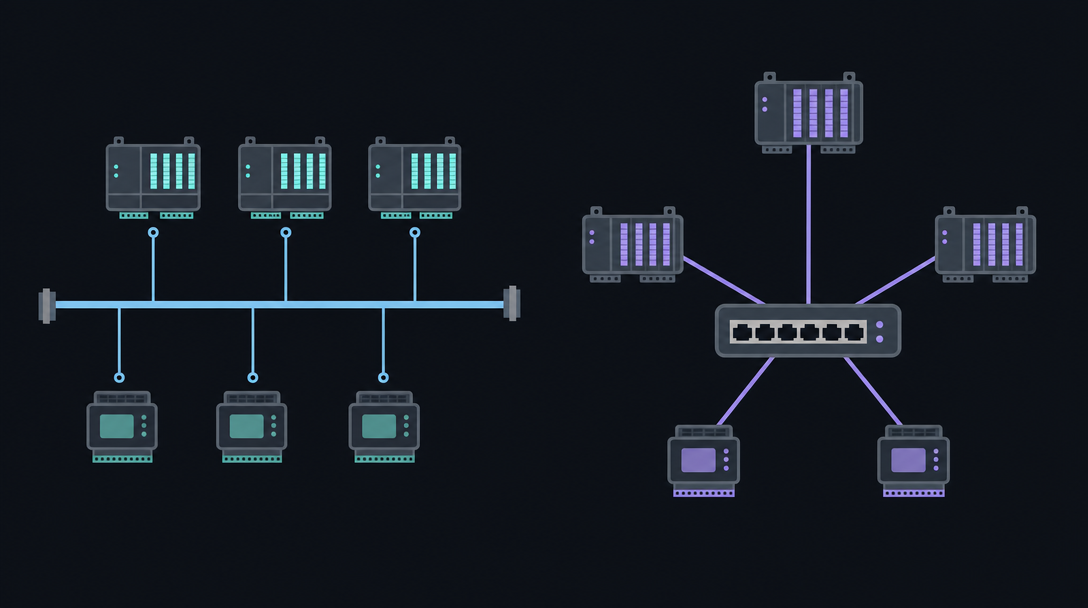
You have a machine to design, a retrofit to plan, or perhaps a colleague who told you to “just put Ethernet in and you’ll be fine”. Before you pull cables or select an I/O module, it is worth pausing for a moment. Modbus RTU RS485 and Modbus TCP over Ethernet are both solid, widely supported protocols, but they were built to solve different problems. Choosing the wrong one will not necessarily derail your project on commissioning day, but it will create friction for years: awkward diagnostics, redundant cabling, or IT infrastructure that nobody on the shop floor wants to manage.
In this article we look at both protocols directly, focusing on the criteria that actually matter for machine builders and industrial system integrators.
Modbus RTU RS485: when simplicity is a genuine advantage
Modbus RTU is the most widely used serial protocol in industrial automation, and not simply out of habit. Its physical architecture, based on RS485, has characteristics that still make it the most sensible choice in many situations.
Bus physical architecture
RS485 operates on a bus topology: a single twisted pair of cables runs through the installation, and every node connects in a daisy-chain along that line. In practice, this means:
- A single cable covering distances of up to 1,200 metres
- Up to 32 native nodes per segment (extendable with repeaters)
- Straightforward physical connections, with 120-ohm terminations at each end
In an installation where devices are spread along a production line, an RS485 bus often results in less overall cabling than an Ethernet star network.
Immunity to electromagnetic interference
The differential transmission of RS485 makes it naturally robust in environments with motors, inverters, welding equipment, or other sources of electromagnetic noise. It is not immune to everything, but it handles the typical conditions found inside an industrial control panel well, particularly when the cabling is done correctly using screened cables and clean earth connections.
Low, deterministic latency
In Modbus RTU, communication is synchronous and sequential: the master polls one slave, waits for the response, then moves on to the next. Latency is predictable and depends on the baud rate and the number of nodes on the bus. At 115,200 baud, reading a register from a single slave takes just a few milliseconds. It is not a real-time protocol in the strictest sense, but for the vast majority of control loops on industrial machines it is more than adequate.
When to choose Modbus RTU RS485
Choose Modbus RTU RS485 when:
- The installation has a linear topology, or devices are arranged along a physical path
- There is no existing Ethernet infrastructure in the field
- The environment has significant electromagnetic interference and you do not want to add switches and patch panels to maintain
- The infrastructure budget is tight
- You are working with PLCs or controllers that already have a native RS485 port
Modbus TCP: when industrial Ethernet opens up possibilities that RS485 cannot match
Modbus TCP encapsulates the Modbus protocol over TCP/IP, which means it travels across any standard Ethernet network. This fundamentally changes the architecture you can build.
Star topology and multi-master access
Ethernet is not a bus: each device has its own dedicated connection to a switch. This eliminates termination issues, removes dependence on the physical order of nodes, and does away with the per-segment device limits. With an industrial switch you can manage dozens of I/O modules on a single network.
Modbus TCP also natively supports simultaneous connections from multiple masters. A PLC can control the I/O while a SCADA system reads the same registers for supervisory purposes, without any conflicts.
Integration with IT infrastructure
If the installation needs to communicate with MES or ERP systems, or with supervisory dashboards accessible via a browser, Modbus TCP connects directly to the site network. There is no need for a serial-to-Ethernet gateway: data travels natively over IP from the I/O board all the way to the data collection server.
This is particularly useful in retrofit scenarios where you want to add data acquisition to existing machines without touching the field cabling.
Diagnostics and troubleshooting
On an Ethernet network you can use standard tools such as Wireshark to capture and analyse Modbus TCP traffic in real time. You can see every transaction, response times, and connection errors. On RS485, diagnostics are more involved and require dedicated hardware or serial analysers.
Network latency: the constraint you cannot ignore
Modbus TCP adds a layer of overhead compared to RTU: the TCP/IP header, connection management, and the variable latency introduced by a switch. Under normal conditions on a dedicated local network, latency is in the order of a millisecond, which is acceptable for almost all control loops on industrial machines.
It only becomes a problem in very fast loops, below 5-10 ms, or when the network is shared with unprioritised IT traffic. In that case, you either segment the network with dedicated VLANs or reconsider the architecture.
When to choose Modbus TCP
Choose Modbus TCP when:
- The installation is already cabled with industrial Ethernet, or the layout calls for a star topology
- You need remote access to data or integration with SCADA and MES systems
- You need multiple masters reading the same data simultaneously
- Remote diagnostics is a requirement from the end customer
- The number of nodes exceeds the practical limits of an RS485 bus
Network security: a difference worth taking seriously
RS485 is a physically isolated network: to access it, you must be physically connected to the cable. This is at once its limitation and its natural protection.
Modbus TCP over Ethernet exposes devices to the corporate network, and potentially to the internet if network segmentation is not properly managed. Modbus TCP has no native authentication mechanisms: anyone who can reach the device on the network can read and write registers. In an industrial context, this means that security must be managed at network level, using firewalls, VLANs and access control lists on the switches.
This is not a reason to avoid Modbus TCP, but it is a design requirement that must not be overlooked.
Infrastructure costs: not just the cost of the module
The cost of a Modbus RTU I/O module and a Modbus TCP module is often comparable. The difference lies in the infrastructure:
RS485 requires shielded twisted-pair cables, terminators and, where necessary, repeaters for long distances. None of this is expensive, but it does need to be properly specified.
Ethernet requires industrial switches, Cat5e/Cat6 cables with RJ45 or M12 connectors, and in some cases patch panels in the control cabinets. The cost per additional node is higher, but the network can be shared with other systems. There is no single answer as to which is cheaper: it depends on how many nodes you have, the system topology and what is already installed.
A practical checklist: how to make clear-cut decisions
Before making your choice, answer these questions:
- System topology: are the devices arranged in a line or in a distributed configuration with varying distances?
- Linear, with distances up to 1200 m: RS485 is probably more efficient
- Distributed in a star configuration or with many branches: Ethernet simplifies cabling
- Existing infrastructure: is there already industrial Ethernet cabling in place?
- Yes: Modbus TCP integrates at no extra cost
- No: consider whether the cost of installing the Ethernet network is justified by the benefits
- Supervision and integration requirements: does the customer or the specification require remote access, SCADA, or integration with IT systems?
- Yes: Modbus TCP is almost always the only option
- No: RS485 is sufficient and simpler to manage
- Electromagnetic environment: does the plant have power inverters, welding machines, or other significant sources of interference?
- Highly disturbed environments with long cable runs: RS485 with shielded cables is more robust than non-industrial Ethernet
- Standard environments: both work with the correct precautions Number of nodes and polling frequency: do you have more than 20–30 devices and frequent polling loops?
- Many nodes with fast polling: Modbus TCP with multiple parallel connections may be more efficient
- Few nodes with moderate polling cycles: RS485 is never the bottleneck
- On-site maintenance expertise: who will manage the system once it is fully operational?
- On-site maintenance skills: who will manage the system once it is fully operational?
- Electricians with experience in PLCs and serial networks: RS485 is more familiar
- Teams with IT/networking skills: Ethernet is easier to diagnose
If your answers were mixed, consider a hybrid architecture: Modbus TCP to the supervision level, with RTU/TCP gateways for field segments where RS485 is already established.
Conclusions
Modbus RTU RS485 remains the go-to protocol for compact field networks, noisy environments and installations where simplicity of infrastructure is a key consideration. Modbus TCP is the natural choice when the installation needs to communicate with IT systems, when remote diagnostics are a requirement, or when the physical topology favours a star network.
There is no single ‘best’ protocol: there is simply the one best suited to your specific context. If you are designing a new machine or considering a retrofit and wish to compare the options using technical data, please contact us to arrange a technical call with the CTA Electronics team.